Elliptocytosis
Created 21 December 2019.
Updated 13 January 2021 (incorporated into atlas from original blog entry)
Updated 23 September 2022 (incorporated new case and more references)
Updated 30 April 2025 (incorporated new case and more references)
Updated 6 January 2026 (Updated to new format)
Elliptocytes can occur in many
conditions (e.g. iron deficiency, leukemias, megaloblastic anemias,
myeloproliferative diseases, myelodysplastic syndromes) but do not reach
the proportions observed in patients with hereditary elliptocytosis…
|
|
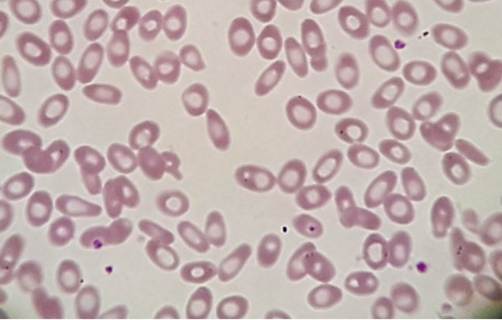
Look at this !!! A ten-year-old child turned up at A&E
four days before Christmas with a fever. The blood count was rather
unremarkable, but my colleague made a blood film purely because the patient
was a child. Rather unscientific perhaps, but I must admit that I tend to err
on the side of caution. But look at those red cells… |
|
|
Another complete chance finding |
|
|
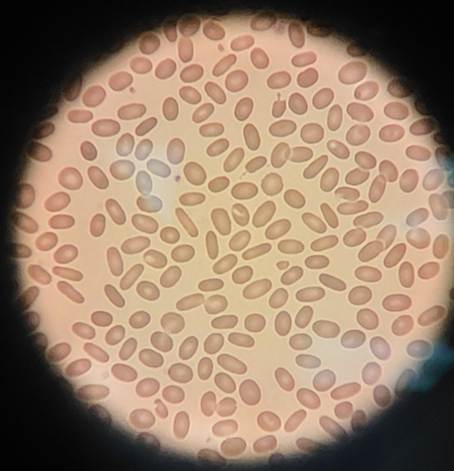
And here’s another that turned up on a Friday in September A complete chance finding in a
teenaged child with an unexplained (and utterly unconnected)
neutropenia. |
Here’s an interesting one – a TATT from the GP…
|
M6795349 NAME
03.05.73 F Specimen H,25.7719927.Y Clin dets Collected 30.04.25 09:24 A.Diag ---------------------------------------------------------------------------- Hb - 64
|Eosin 0.10 WBC 5.33
|Baso 0.02 Plts 359
|MPV 11.9 Hct - 0.233 |PCT
0.43 RBC - 3.09
|NRBC 0.01 MCV - 75.4
|RETP 4.4 MCH - 20.7
|RETA + 135.00 MCHC - 275 |IRF
26.3 Neuts 3.67 | Lymphs 1.10 | Monos 0.44 |
|
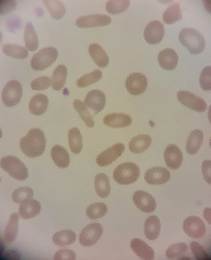
Usually people with H.E. have “normal” MCV, but this one was
microcytic… don’t forget that despite having H.E., people can still get iron
deficient.
If anything they are probably more likely to get iron deficient than the
average person as they’ve got an admittedly compensated haemolytic process
going on.
I’ve seen elliptocytosis several times before. The case which I remember
most (the first one I found myself!) was an eighty-six year old chap
with a chest infection.
Just like in these cases the elliptocytosis was seen as a chance finding and is
benign.
Some More Expert Opinion…
My original blog entry on the
matter
https://path.upmc.edu/cases/case623/dx.html
https://www.ijhsr.org/IJHSR_Vol.5_Issue.9_Sep2015/93.pdf
https://onlinelibrary.wiley.com/doi/full/10.1111/j.1365-2141.1999.01130.x
https://imagebank.hematology.org/image/65014/hereditary-elliptocytosis
https://rarediseases.info.nih.gov/diseases/6621/hereditary-elliptocytosis